

Building More Than Data
Data centers fuel construction demand, create high-paying jobs, strengthen local supply chains, and generate long-term investment in communities across the country.

As demand for cloud computing, artificial intelligence, online banking, telehealth, and other digital services grows, so does the need for the physical infrastructure that powers them. Data center development creates economic activity far beyond the facility itself—supporting construction, suppliers, workforce development, and local communities.
Immediate Economic Impact
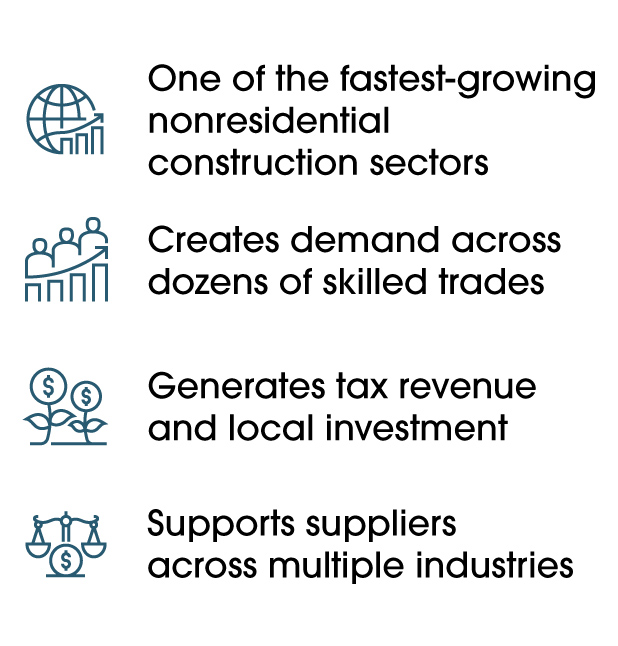
Data centers are one of the fastest-growing segments of nonresidential construction. According to Census Bureau data, data center construction spending reached $59.3 billion at a seasonally adjusted annual rate in May 2026, up 23 percent from one year earlier.
While data centers still represent a relatively small share of private nonresidential construction, that share is growing. As of May 2026, data centers accounted for approximately 8.0 percent of private nonresidential construction spending.
Contractors also expect continued demand. According to AGC’s 2026 Outlook Survey, 57 percent of contractors expect the available dollar value of data center projects in 2026 to exceed 2025 levels.
Benefits to Local Suppliers and Businesses
Data center construction creates economic activity that extends well beyond the project site. These projects require contractors, suppliers, manufacturers, engineers, transportation providers, and other service firms throughout the economy.
Direct impacts include construction jobs, wages, materials, and equipment purchases at the project site.
Indirect impacts include increased demand for upstream suppliers, including transformers, electrical components, cooling systems, building materials, architectural services, engineering services, and trucking.
Induced impacts occur when workers and business owners spend income earned through construction and supply chain activity on housing, food, retail, and local services.
As a result, the economic benefits of data center construction can spread throughout a broad network of contractors, manufacturers, suppliers, and local businesses.
Construction and Workforce Benefits
Data centers are highly complex construction projects. These facilities require specialized electrical systems, backup power generation, cooling equipment, fiber connectivity, security systems, and extensive utility infrastructure.
That complexity creates demand for a wide range of skilled trades and construction professionals, including electricians, operating engineers, concrete specialists, ironworkers, plumbers, pipefitters, truck drivers, project managers, and engineers.
Data center construction also supports high-paying career pathways. As of March 2026, average hourly earnings in construction were up 5.0 percent from one year earlier, compared with 3.4 percent across the private sector. Construction workers also earned 20.4 percent more, on average, than private-sector workers overall.
Real-World Economic Impact Examples
The economic impact of data centers varies widely depending on project size, scope, location, and the type of analysis used. A single mid-sized facility will generate a different level of impact than a larger, multi-project data center corridor.
A 2025 study examining the comparative economic impacts of data centers and manufacturing centers in Ohio found that a data center project could support nearly 9,700 construction jobs during the build phase, generate $2.4 billion in total economic output per project, contribute $1 billion to state GDP, and generate approximately $84 million in annual peak state and local tax revenues.
The Virginia JLARC Data Center Study found that data centers supported nearly 74,000 jobs annually, including construction and ripple effects, and generated $9.1 billion in annual economic contribution to Virginia’s GDP. In some jurisdictions, data centers accounted for up to approximately 30 percent of local tax revenue.
Community-Linked Development Opportunities
As competition for land, power, and permits increases, localities have opportunities to negotiate community benefits tied to data center development.
Some emerging development models include workforce training programs, university and research partnerships, local industry collaboration, energy infrastructure commitments, and water sustainability efforts.
These approaches can help ensure that data center development supports both immediate construction activity and longer-term community priorities.
Data Centers Build More Than Technology
Data center development delivers immediate economic impact through construction activity, strengthens local supply chains, and supports long-term workforce opportunities tied to high-paying construction careers.
When planned and managed effectively, data centers can help communities attract investment, expand the local tax base, support infrastructure improvements, and create economic opportunities that extend well beyond the facility itself.